
Renovation
Roof renovation cost per m² in Belgium: prices, steps and grants
Tiles, slates or a flat roof: what a roof renovation costs per m² in Belgium, which steps to plan for and what support is still available in 2026.
By the RhinoEnergy advisersUpdated on 7 min read
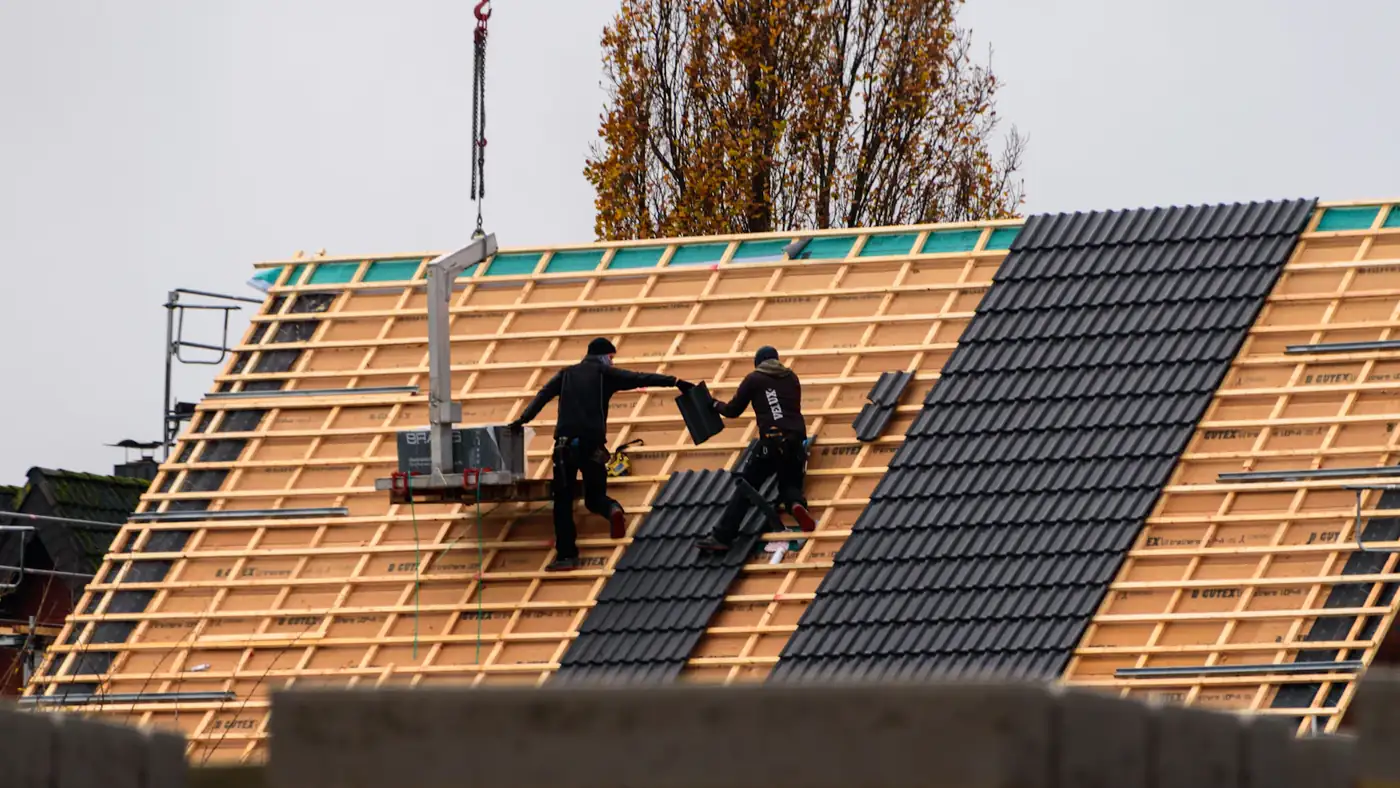
The cost of a roof renovation depends first on what is actually being redone: replacing a few damaged tiles, a completely new roof covering, or a full renovation including the underlay, insulation and zinc work. In Belgium, a complete renovation of a pitched roof generally costs between €150 and €300 per m² including VAT, but two quotes can differ considerably.
The roof is also the biggest source of heat loss in a poorly insulated house. Redoing your roof is therefore the ideal moment to insulate, and it is often the job with the best ratio between cost and energy savings.
Here are the price ranges to know, the steps of a well-run job and the support still available in 2026 in Brussels, Wallonia and Flanders.
Roof renovation cost per m²: the price ranges
The figures below are ballpark prices including VAT at 6%, supply and fitting included, as seen in Belgium. They do not replace a quote after a site visit.
| Type of work | Indicative price per m² incl. VAT |
|---|---|
| Concrete tile covering (replacement) | about €70 to €110 |
| Clay tile covering (replacement) | about €85 to €140 |
| Artificial (fibre cement) slate covering | about €90 to €150 |
| Natural slate covering | about €150 to €300 |
| Pitched roof insulation (from the inside, between rafters) | about €40 to €90 |
| Flat roof: EPDM or bitumen waterproofing + insulation | about €100 to €200 |
| Full pitched roof renovation (covering, underlay, insulation, zinc work) | about €150 to €300 |
For a house with 100 m² of roof, a full renovation therefore often means a budget of €15,000 to €30,000 including VAT, sometimes more with natural slate or a timber structure that needs strengthening.
What affects the price
Two roofs of the same size can produce very different quotes. The main factors:
- The covering material: natural slate costs far more than concrete tiles, both to buy and to lay.
- The condition of the timber structure: rafters damaged by damp or insects must be treated or replaced.
- The complexity of the roof: dormers, valleys, chimneys, roof windows and multiple pitches all add labour time.
- Site access: scaffolding on a street-facing facade, use of the public highway, a crane or hoist.
- The insulation chosen: type of insulation (mineral wool, wood fibre, PIR), thickness, insulation from the inside or from the outside (sarking).
- Zinc work: gutters, downpipes, verges and flashings in zinc are a significant cost.
- Removal of the old covering, especially if it contains asbestos, which requires removal by a specialist company.
The steps of a roof renovation
A well-run roofing job usually follows this order:
- Inspection: checking the covering, timber structure and gutters, and looking for any asbestos-containing materials.
- Detailed quotes: compare offers item by item (covering, insulation, zinc work, scaffolding, waste removal).
- Paperwork: a change of material, colour or volume, or adding a dormer, may require planning permission. Check with your municipality.
- Removal of the old covering and inspection of the timber structure.
- Fitting the underlay and insulation, with a carefully sealed vapour control layer on the inside.
- Fitting the new covering and the zinc work.
- Handover: check the finishes and junctions, and ask for the technical data sheets of the materials used (useful for grants).
For a single-family house, expect one to three weeks on site as a rule, depending on the weather and the scope of the works.
Insulate at the same time: the smart move
Once the covering is off, insulating costs proportionally much less than doing it later. There are two main techniques:
- Insulation from the inside (between and under the rafters): cheaper, but it slightly reduces the living space under the roof.
- Insulation from the outside (sarking): boards laid over the rafters before the covering; more expensive, but continuous and with no loss of space.
Aim for high-performance insulation: energy performance regulations and grant conditions set a maximum U-value (or a minimum thermal resistance R). Ask the contractor to state these values on the quote.
An insulated roof also prepares the next steps: it is often a prerequisite before switching to a heat pump, and the right moment to consider solar panels if the orientation suits. Our roofing page explains what we check with you before putting you in touch with contractors.
6% VAT on roof renovation
Roof renovation works qualify for the reduced VAT rate of 6% if:
- the home has been occupied for more than 10 years at the time of the first invoice;
- it is mainly used as a private dwelling;
- the works are invoiced directly to the occupant or owner by a registered contractor.
Otherwise, the 21% rate applies. This is a federal rule, so it is the same in all three regions. All the conditions are explained in our article on 6% VAT on renovation and on the FPS Finance website (in French and Dutch).
Which roof grants are available in 2026?
In Wallonia, the Prime Habitation covers the roof and its insulation, and these items are exempt from the prior housing audit. The amount depends on your income category. Note that the current scheme ends on 30 September 2026, the date by which the complete application, final invoice included, must be submitted. A new loan-based system (Rénopack and Rénoprêt) has been announced to follow. Everything is explained in our guide to home renovation grants in Wallonia and on energie.wallonie.be.
In Brussels, Renolution grants are no longer available for works whose final invoice is dated 2025 or 2026, and no new regional scheme had been announced at the time of writing. Some municipalities offer their own grants: ask yours or Homegrade.
In Flanders, roof insulation and roof renovation are covered by Mijn VerbouwPremie, but since 1 March 2026 only for owner-occupiers in the two lower income categories (3 and 4); the two highest categories now only receive a grant for heat pumps. The insulation must reach a minimum thermal resistance and the application is made online after the final invoice. Details are in our guide to Mijn VerbouwPremie in Flanders.
Also bear in mind the Flemish renovation obligation (renovatieverplichting): anyone who has bought a house or flat with EPC label E or F since 1 January 2023 must bring it up to at least label D within a set period (extended to six years in 2026). Roof insulation is often one of the most effective ways to gain a label. The rules are on vlaanderen.be.
Support changes quickly: our energy grants page is updated regularly, and a RhinoEnergy adviser can check your situation when they call you back.
How to compare roofing quotes
- Insist on a quote broken down by item, with the brands, thicknesses and U or R values of the insulation.
- Check that scaffolding, waste removal and zinc work are included.
- Ask for the company's ten-year liability insurance (décennale) and public liability insurance.
- Be wary of door-to-door sellers offering a "today only" price.
- Compare at least two or three offers.
That is exactly RhinoEnergy's role: an adviser calls you back within 24 working hours, clarifies your needs and puts you in touch with up to 3 certified roofers in your area. Free and without obligation.
Frequently asked questions
What is the average roof renovation cost per m² in Belgium?
For a full renovation of a pitched roof (covering, underlay, insulation and zinc work), expect generally between €150 and €300 per m² including VAT. The material, the condition of the timber structure and the complexity of the roof make the price vary widely.
Do I need planning permission to renovate my roof?
Replacing like for like generally does not require permission. Changing the material or colour, altering the volume or adding a dormer may, however. Check with your municipality's planning department before signing.
Does roof renovation qualify for 6% VAT?
Yes, if the home is more than 10 years old, mainly used as a private dwelling and the works are invoiced directly to the occupant by a registered contractor. Otherwise, VAT is 21%.
Do I need a housing audit for the roof grant in Wallonia?
No. Under the 2025-2026 scheme, roofing works and roof or loft insulation are exempt from the prior audit. The application must still be complete, final invoice included, by 30 September 2026.
Can I still get a roof grant in Flanders in 2026?
Yes, through Mijn VerbouwPremie, but since 1 March 2026 only for owner-occupiers in income categories 3 and 4. Households in the two highest categories no longer receive a grant for the roof.