

Home battery · 5 to 15 kWh
Home battery in Brussels, Flanders and Wallonia
A home battery stores the electricity your solar panels generate during the day so you can use it in the evening. It increases your self-consumption, but whether it pays off depends heavily on your profile. A RhinoEnergy adviser assesses with you whether it makes sense before offering you up to 3 quotes.
You are…
This changes the grants you are entitled to.
Free, no commitment. Your data is never sold.
- Typical capacity for a single-family home
- 5 to 15 kWh
- Typical capacity for a single-family home
- Share of output typically self-consumed without a battery
- 30 to 40%
- Share of output typically self-consumed without a battery
- Common manufacturer warranty period
- 10 years
- Common manufacturer warranty period
- More of your solar output used at home
- Less electricity bought at peak prices in the evening
- Capacity calculated on your actual consumption
What does a home battery do?
Without a battery, much of your solar output is fed into the grid during the day, when nobody is home, then bought back in the evening at a higher price. Depending on the household, only 30 to 40% of the output is generally used directly. The battery stores this surplus and releases it when you need it, which significantly increases your self-sufficiency.
Most current batteries use lithium iron phosphate (LFP) technology, known for its stability and durability. They connect either to a hybrid inverter, which manages both the panels and the storage, or to a dedicated inverter when a solar system is already in place. The adviser checks the compatibility of your existing equipment before making any recommendation.
Does it pay off in Belgium?
Profitability depends on the gap between the price you pay for electricity and the price you are paid for what you feed in. In Flanders, where the meter no longer runs backwards and the capacity tariff rewards lower peaks, and in Wallonia, where new solar systems have not had net metering since 2024, every kWh stored rather than exported is worth more. Households that are out during the day and use most of their power in the evening benefit the most.
Conversely, a battery that is too large for your production or your evening consumption will sit partly unused. That is why we never assume that bigger is better: the adviser starts from your meter readings to estimate the useful capacity and a realistic saving.
Choosing the right capacity
For a house, 5 to 10 kWh generally covers an evening's needs. Beyond that, the benefit depends on the size of the solar system and on specific uses, such as charging an electric car or running a heat pump. Many systems are modular: you can start small and add modules later.
Some batteries can also provide backup power during an outage, provided the inverter supports it. Mention this need from the start, as it affects the choice of equipment and the wiring. The chosen location must also be ventilated, frost-free and accessible for maintenance, which the installer checks during the site visit.
Indicative prices 2026
How much does a home battery project cost?
Prices depend on capacity, compatibility with your inverter and the backup function; the VAT rate (6% or 21%) depends in particular on the age of the property and will be confirmed by the installer.
| Work | Range incl. VAT | Best for |
|---|---|---|
| 5 kWh battery, installed | €3,500 – €6,000 | On a compatible existing solar system |
| 10 kWh battery, installed | €6,000 – €9,500 | Most requested capacity |
| 15 kWh battery, installed | €8,500 – €13,000 | Large system or electric car |
| Hybrid inverter, if replacement is needed | €1,000 – €2,500 | Depending on output and brand |
Average ranges seen in Belgium, before grants. Only the quote issued after a site visit is binding.
With RhinoEnergy
From question to the right quote
- 1
2 minutes
You describe your project
A few simple questions online, no account needed. You get a first estimate straight away.
- 2
Within 24 working hours
An adviser calls you back
They check feasibility, the grants you are entitled to and a realistic budget for your home.
- 3
Within 2 weeks
You compare up to 3 quotes
Certified installers from your area visit your home. You choose freely, or no one at all.
Frequently asked questions
Home battery: your questions
Is a battery useful without solar panels?
Rarely for a household. Its main purpose is to store your own production. Some dynamic tariff contracts let you charge during the cheapest hours, but the saving remains limited and has to be calculated case by case.
What capacity should I choose for my home?
For most houses, 5 to 10 kWh is enough to cover the evening. The right choice depends on your solar output and your consumption after sunset, which the adviser analyses with you.
How long does a home battery last?
Manufacturers often guarantee their batteries for 10 years, with a minimum residual capacity at the end of the warranty. Actual lifespan depends on the number of cycles and the installation conditions.
Is an electrical inspection required?
Yes. Adding a battery changes your electrical installation: it must comply with the RGIE/AREI, be inspected by an approved body and be reported to the grid operator.
Our guides to go further
All guides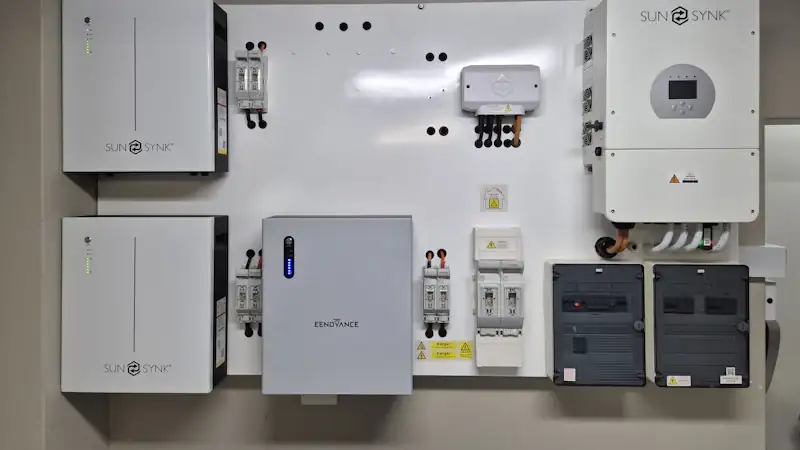 Solar
Is a home battery worth it in Belgium in 2026?
A battery lets you store your solar surplus for the evening. But do the savings cover the price? Calculations, favourable cases and mistakes to avoid.
7 min
End of Walloon grants: what changes on 1 October 2026
30 September 2026 is the last day to apply for a Walloon renovation grant. What replaces it, who qualifies, and what still remains afterwards.
8 min
 Grants & aid
Mijn VerbouwPremie in Flanders: what changed in 2026
Since 1 March 2026, the Flemish renovation grant is reserved for lower incomes, except for heat pumps. Who still qualifies, for which works and how to apply.
7 min
Other projects in mind?
Solar panels
Generate your own electricity and cut your energy bill.
Prices, grants and quotesEV charger
Charge your electric car safely at home.
Prices, grants and quotesHeat pump
Heat your home without gas or heating oil.
Prices, grants and quotesRoofing
Renovate and insulate your roof for years of peace of mind.
Prices, grants and quotes
Your home battery project, estimated in 2 minutes
Two minutes for a first estimate, an adviser to check it, up to three quotes to decide.