
Solar
Is a home battery worth it in Belgium in 2026?
A battery lets you store your solar surplus for the evening. But do the savings cover the price? Calculations, favourable cases and mistakes to avoid.
By the RhinoEnergy advisersUpdated on 7 min read
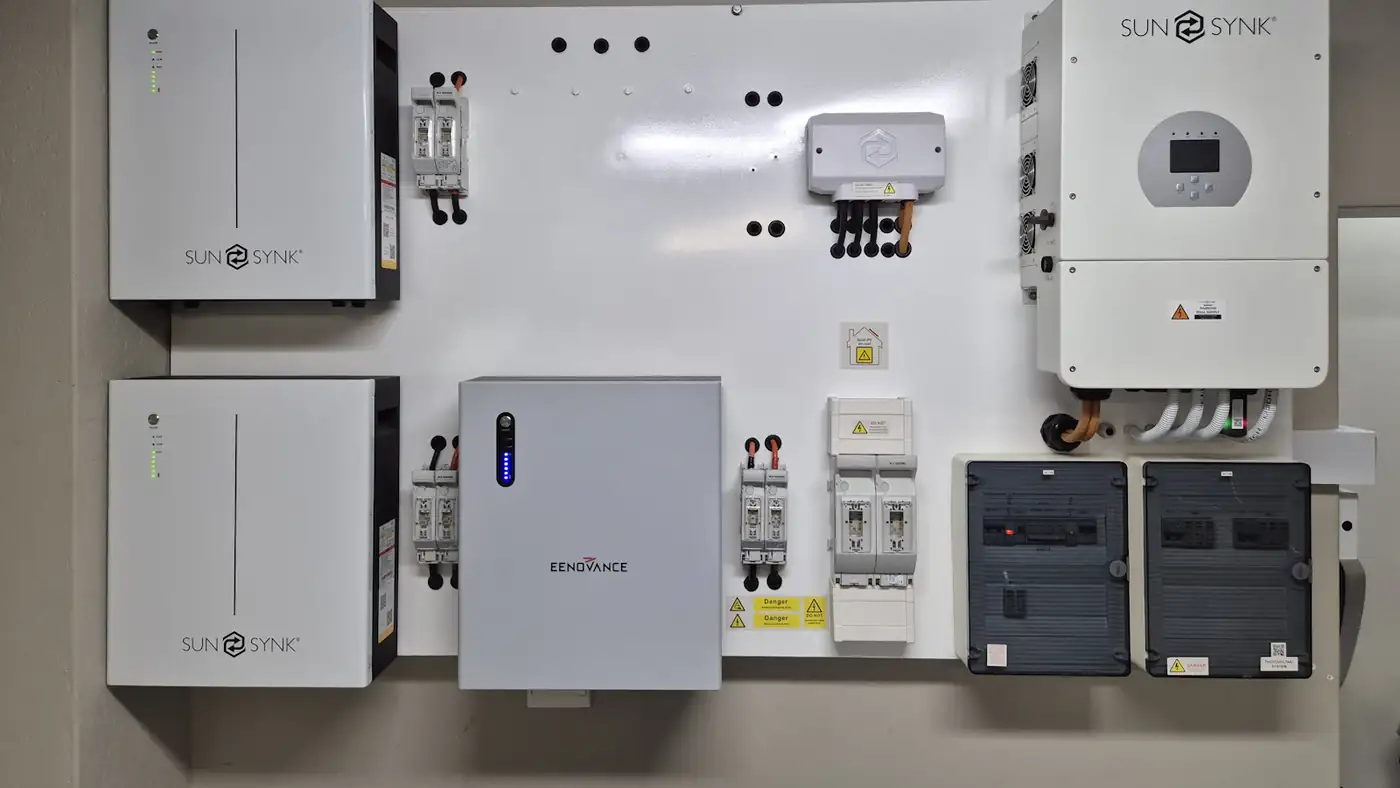
A home battery has become one of the most talked-about topics in Belgium since the end of net metering in Wallonia and the phasing out of the reversing meter in Flanders. The idea is appealing: store the electricity your solar panels produce during the day and use it in the evening, rather than exporting it to the grid for a few cents. But a battery costs several thousand euros, and the question of whether it pays off deserves an honest answer.
In short: in 2026, a battery can be worthwhile in certain specific situations, but it is not automatically a good investment. It all depends on your solar system, your evening consumption, your electricity contract, your region and the date your panels were commissioned. Here is how to work it out.
How a home battery works
A home battery, almost always lithium-based (often LFP, lithium iron phosphate), is connected to your solar PV system:
- during the day, when your panels produce more than you use, the surplus charges the battery instead of being exported;
- in the evening and at night, the battery feeds that energy back into the home;
- when it is empty, you draw electricity from the grid as usual.
It can be paired with a hybrid inverter (which manages both panels and battery) or added to an existing system with its own inverter. Some models also offer a backup function in the event of a power cut, but not all do: check this if it matters to you.
Without a battery, a household typically self-consumes 25 to 40% of its solar output. A well-sized battery can raise that to 60 or 70%, sometimes more.
Home battery prices in 2026
Prices have fallen noticeably in recent years. Here are indicative ranges including VAT and installation, for a home more than 10 years old (6% VAT):
| Usable capacity | Suitable profile | Indicative price incl. 6% VAT |
|---|---|---|
| 5 kWh | Low evening consumption, 3 to 4 kWp system | €4,000 to €6,000 |
| 10 kWh | Family, 5 to 8 kWp system | €6,000 to €9,000 |
| 15 kWh and more | High consumption, heat pump, electric car | €9,000 to €15,000 |
What makes the price vary:
- the brand and the warranty (often 10 years, with a guaranteed number of cycles or residual capacity);
- whether a new hybrid inverter is needed;
- the backup function and any changes to the consumer unit;
- the location (garage, cellar, utility room) and the length of cabling.
A battery fitted at the same time as the panels generally costs less than one added later, because the inverter and labour are shared. For the cost of the panels themselves, see our article on solar panel prices in Belgium.
Working out the return, step by step
Every kWh stored and used in the evening saves you the difference between the price of buying electricity from the grid and the price you would have been paid for exporting it. As an order of magnitude:
- a kWh bought from the grid often costs between €0.25 and €0.40 including VAT;
- an exported kWh is often worth a few cents;
- the gain per kWh shifted is therefore often around €0.20 to €0.35.
The remaining question is how many kWh the battery will actually shift each year. In Belgium, solar output is low from November to February, so the battery rarely fills up in winter. A 10 kWh battery often completes the equivalent of 150 to 250 full cycles a year.
| Assumption (10 kWh battery) | Indicative value |
|---|---|
| Energy shifted per year | 1,200 to 2,000 kWh |
| Gain per kWh shifted | €0.20 to €0.35 |
| Annual saving | around €250 to €600 |
| Installed price | €6,000 to €9,000 |
| Indicative payback | often 12 to 20 years |
A battery's lifespan, however, is generally estimated at 10 to 15 years depending on use and model. That is why, in many situations, the payback period ends up close to the equipment's lifespan. These figures are orders of magnitude: a personalised study based on your own consumption data is essential.
When a battery becomes worthwhile
A battery makes more sense when several of these conditions are met:
- Your solar system has no net metering: in Wallonia, systems commissioned since 1 January 2024; in Flanders, homes with a digital meter; in Brussels, all systems.
- You export a lot: a fairly large system compared with your daytime consumption.
- You mostly use electricity in the evening: nobody home during the day, electric cooking, electric hot water.
- You have a dynamic contract or time-of-use tariff, which lets you charge the battery when electricity is cheap and use it at expensive times, with suitable control software.
- You value partial independence during a power cut, with a model that has a backup function.
In Flanders, the capacity tariff adds another angle: part of your network charges depends on your average monthly peak demand. A smartly controlled battery can help flatten those peaks, for instance when the oven, heat pump and car charger run at the same time. The saving remains modest and depends heavily on your habits, but it is worth including in the calculation. The Flemish regulator explains the capacity tariff in detail.
In Wallonia, grid operators are also moving towards tariffs that vary by time of day. This kind of pricing may make controlled storage more attractive in the future: find out about the options offered by your grid operator and on the website of the regulator, the CWaPE.
When it is not worthwhile
Conversely, a battery offers little financial benefit if:
- you still have net metering in Wallonia (system commissioned before 2024): until the end of 2030, the grid already acts as a free battery over the year;
- your system is small and you already use most of the output during the day;
- you are often at home during the day, working from home for example, with naturally high self-consumption;
- you have not yet used the free levers: timers on appliances, controlling the water heater, charging the car during the day.
In Brussels, green certificates are calculated on the system's output, not on self-consumption: a battery therefore makes no difference to that support. It only affects the share of electricity you avoid buying. For an overview, read our article on whether solar panels are worth it in Belgium.
Grants, VAT and paperwork
As far as we know, there is no specific regional grant for home batteries in Brussels or Wallonia in 2026. In Flanders, the former home battery premium was discontinued: installations after 31 March 2023 no longer qualify. Rules change regularly: check the situation at the time of your project on our energy grants page or with your region.
On the other hand, 6% VAT may apply when the battery is supplied and installed by a contractor in a private home more than 10 years old. Otherwise, the rate is in principle 21%.
As for paperwork, the installer must have the system inspected by an approved body and notify it, including the battery, to the grid operator (Fluvius, Sibelga, ORES, RESA, etc.). Choose a professional who is comfortable with both solar PV and storage: our guide to choosing a solar installer will help you.
Our advice before investing
Before deciding, follow this simple order: first size your panels correctly, then optimise your usage for a season, and finally assess a battery using your real export figures. If you are installing panels now, ask for a hybrid inverter: it will let you add a battery later without changing everything.
A RhinoEnergy adviser can analyse your situation free of charge and with no obligation. They call you back within 24 working hours, check whether a battery makes sense for you, then put you in touch with up to 3 certified installers in your area. Find out more on our home battery page.
Frequently asked questions
What battery capacity should I choose?
As a rule, usable capacity should match your evening and night-time consumption, often between 5 and 10 kWh for a family. An oversized battery will rarely be full, especially in winter. The installer should size it from your consumption and production data.
Will a battery keep the power on during a cut?
Not necessarily. Only batteries with a backup function, correctly wired, can power all or part of the home during a grid outage. Mention this need when you request a quote, as it affects the equipment and the price.
Can I add a battery to an existing solar system?
Yes, in most cases. Depending on the inverter in place, the battery will be connected with its own inverter or the existing inverter will need replacing with a hybrid model. The cost is generally a little higher than a battery fitted at the same time as the panels.
How long does a home battery last?
Lifespan is generally between 10 and 15 years, depending on the number of cycles and operating conditions. Manufacturers often offer a 10-year warranty with a guaranteed minimum residual capacity. Compare these terms between models.
Is there a grant for home batteries in 2026?
As far as we know, there is no specific regional grant for home batteries in Brussels, Wallonia or Flanders in 2026; the Flemish premium ended for installations after 31 March 2023. However, 6% VAT may apply in homes more than 10 years old. Check the situation when you start your project, as support changes.