
Renovation
External wall insulation in Belgium: cost, techniques and grants
Insulated render, ventilated cladding or brick slips: what external wall insulation costs in Belgium, how to get it right and what support is available.
By the RhinoEnergy advisersUpdated on 7 min read
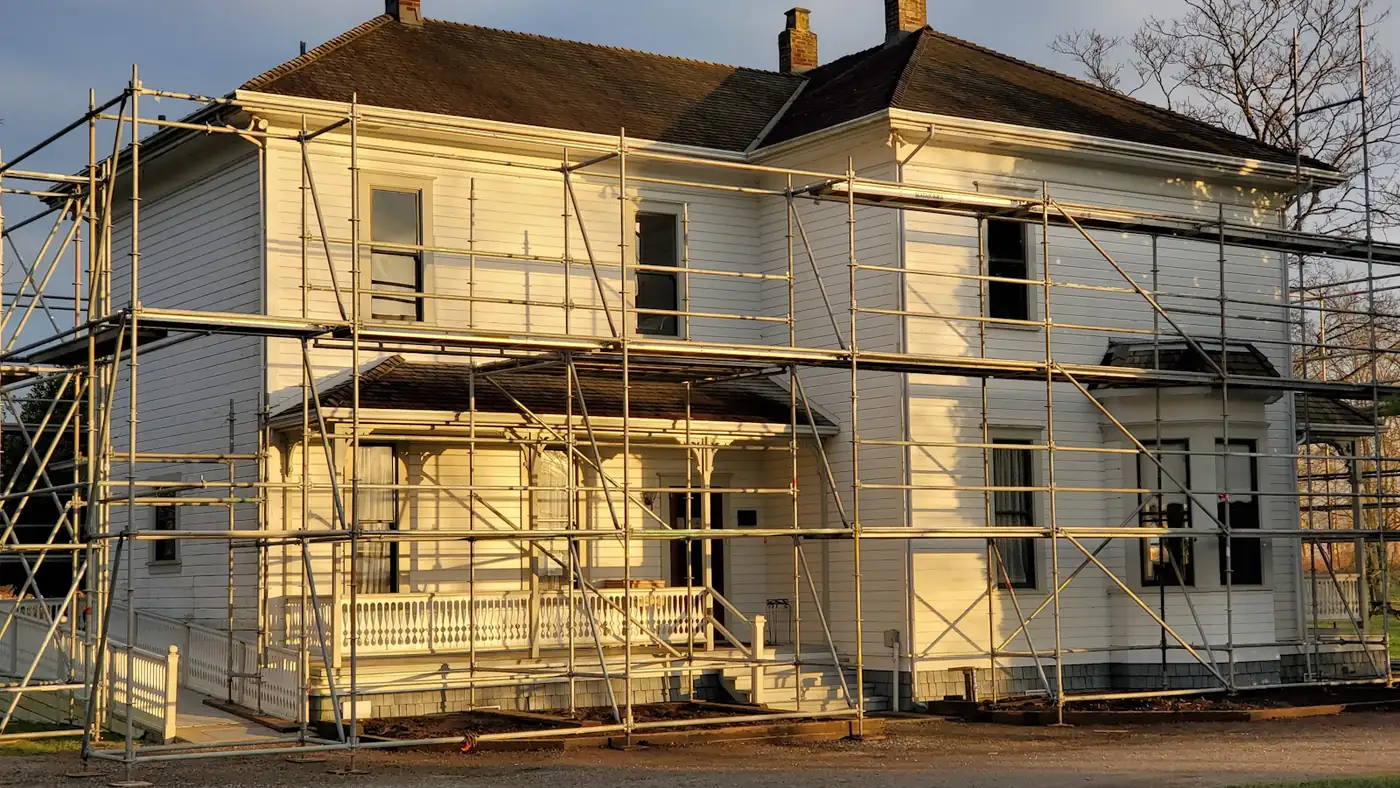
External wall insulation means wrapping the walls of the house in a layer of insulation, then a new finish: render, cladding or brick slips. It is the most effective way to insulate solid walls, which are common in Belgian houses built before the 1970s, because it eliminates most thermal bridges without reducing the living space.
It is also a substantial job that changes the look of the house and often requires planning permission. Well prepared, it clearly improves comfort, ends the feeling of cold walls and cuts heating consumption.
Here are the techniques available, the prices per m² seen in Belgium, the formalities to plan for and the support you can use.
Why insulate from the outside rather than the inside?
For a solid wall there are three options: insulate from the inside, fill a cavity if there is one, or insulate from the outside. External insulation has several advantages:
- no loss of living space and no works inside the living areas;
- continuous treatment of thermal bridges (floor slabs, internal walls, junctions);
- the walls stay on the warm side: they store heat and the risk of interstitial condensation falls;
- the facade is renovated at the same time, which often solves an appearance or water ingress problem.
Its limits: a higher cost, a change to the outside appearance, and tricky detailing on terraced houses or on a street-facing facade that opens directly onto the pavement. If your wall has a cavity, cavity wall insulation by blowing in insulation is often much cheaper: have it checked first. Our insulation page presents the different options.
The three main techniques
1. Insulated render (ETICS). Insulation boards (expanded polystyrene, graphite polystyrene, stone wool or wood fibre) are bonded and anchored to the wall, then covered with a reinforced base coat and a finishing render. This is the most widespread technique and, as a rule, the most economical.
2. Ventilated cladding. The insulation is fixed within a framework, then covered with a facing (timber, fibre cement, composite, metal) with a ventilated air gap. It is more tolerant of damp walls and gives a more architectural result.
3. Brick slips. Thin clay slips bonded onto the insulation give the look of a brick facade. It is often the most expensive finish, but it respects the character of streets where brick dominates.
External wall insulation cost per m²
The ranges below are ballpark prices including VAT at 6%, supply, fitting and scaffolding included, as seen in Belgium. They vary with the insulation thickness, the condition of the wall and access.
| Technique | Indicative price per m² of facade incl. VAT |
|---|---|
| ETICS with polystyrene (EPS) insulation and render | about €110 to €170 |
| ETICS with stone wool or wood fibre and render | about €130 to €200 |
| Ventilated cladding (timber, fibre cement, composite) | about €130 to €220 |
| Brick slips on insulation | about €180 to €260 |
For a semi-detached house with around 120 m² of wall to insulate, the budget is therefore often between €15,000 and €30,000 including VAT. The factors that make the price vary:
- the thickness and type of insulation: the higher the performance target, the thicker the insulation;
- the condition of the wall: repairing cracks, treating damp, stripping old paint;
- the number of openings: each window needs insulated reveals, new sills and sometimes moving the frames;
- items to relocate: downpipes, lights, letterbox, meters;
- access: height, scaffolding, use of the public highway.
The formalities not to forget
Insulating a facade from the outside changes its thickness and appearance. Before signing:
- Planning: check with your municipality. Depending on the region, the facade concerned (street-facing or rear), a change of material or colour and the context (conservation area, listed building), planning permission may be required.
- Street-facing facade: if the insulation projects over the pavement, permission from the municipality or the road authority is generally needed.
- Party walls: plan the junction with neighbouring houses and talk to your neighbours before work starts.
- Ventilation: a better-insulated house becomes more airtight; make sure wet rooms are properly ventilated to avoid condensation.
Coordinating the facade and the windows
The most common mistake is insulating the facade without thinking about the windows. Ideally:
- replace the windows before or during the insulation works, bringing them forward into the plane of the insulation to avoid a thermal bridge around the opening;
- if the windows are recent, plan a careful return of insulation into the reveals;
- make the most of the scaffolding to deal with the roof or the eaves.
This whole-house logic is also the one followed by energy audits: the building envelope first, then the heating system. A well-insulated house can, for example, run on a smaller and more efficient heat pump. Our facade page sums up what we check with you.
VAT and grants for external wall insulation
VAT. In a home more than 10 years old that is mainly used as a private dwelling, insulation works invoiced by a registered contractor qualify for the 6% rate instead of 21%. This federal rule applies in all three regions; the conditions are set out in our guide to 6% VAT on renovation.
In Wallonia. Wall insulation is covered by the Prime Habitation, whose amount depends on your income category. For this item, a prior housing audit is compulsory. The current scheme ends on 30 September 2026 (complete application, final invoice included), and a new loan-based system has been announced to follow. Details in our guide to home renovation grants in Wallonia and on energie.wallonie.be.
In Brussels. According to renolution.brussels, Renolution grants can no longer be claimed for works whose final invoice is dated 2025 or 2026, and no new form of regional support had been decided at the time of writing. Check with your municipality: some offer their own grants.
In Flanders. External wall insulation is one of the items covered by Mijn VerbouwPremie, with a minimum thermal resistance to reach and an online application after the final invoice. Since 1 March 2026, however, only owner-occupiers in the two lower income categories (3 and 4) can still claim it for insulation; the two highest categories now only receive a grant for heat pumps. If you bought a home with EPC label E or F, the Flemish renovation obligation also requires you to reach at least label D within a set period, and facade insulation is often part of the answer. See our guide to Mijn VerbouwPremie in Flanders and the official page on the renovation obligation.
How to choose your contractor
- Ask for a detailed quote: type, brand and thickness of the insulation, target U-value or thermal resistance R, type of render or facing, treatment of the openings.
- Check that the system is certified as a whole (adhesive, insulation, mesh and render from the same range).
- Ask for references from similar jobs and the ten-year liability insurance.
- Compare at least two or three offers.
RhinoEnergy supports you free of charge: an adviser calls you back within 24 working hours, reviews your project and the support available, then puts you in touch with up to 3 certified facade contractors in your area, without obligation.
Frequently asked questions
How much does external wall insulation cost in Belgium?
As a rule, expect about €110 to €200 per m² including VAT for insulated render, more for high-end cladding or brick slips. The insulation thickness, the condition of the wall, the number of windows and the scaffolding all affect the price.
Do I need planning permission for external wall insulation?
Often yes, because the facade changes in thickness and appearance, especially on the street side. The rules vary by region and municipality: contact the planning department before signing the quote.
How thick should the insulation be?
It depends on the insulation material chosen and on the performance required by energy regulations or grant conditions. In practice, thicknesses of 12 to 20 cm are common; your contractor should state the resulting U or R value on the quote.
Can a terraced house be insulated from the outside?
Yes, but the junction with the neighbouring facades and any projection over the pavement need to be studied. It is advisable to talk to your neighbours and the municipality before work starts.
Is there a grant for external wall insulation in Flanders?
Yes, through Mijn VerbouwPremie, provided the insulation reaches the required thermal resistance. Since 1 March 2026 the grant for insulation is reserved for owner-occupiers in income categories 3 and 4.