
Heating
Heat pump in an older house: can it work in a renovation?
A heat pump can heat an older house, provided a few rules on insulation, radiators and flow temperature are respected. Here is what to check before you ask for quotes.
By the RhinoEnergy advisersUpdated on 6 min read

Installing a heat pump in an older house, whether it dates from the 1930s or the 1970s, is perfectly possible. It is not automatic, though: a heat pump fitted in a poorly insulated home with small radiators may use a lot of electricity and struggle to keep up during a cold snap. The problem is rarely the heat pump itself; it is the match between the machine and the house.
So the real question is not "can it be done?" but "under what conditions will it work well?". Three things decide the answer: how well the house is insulated, what emits the heat (radiators or underfloor heating) and the water flow temperature the house needs. This guide helps you assess your own situation before you ask installers for quotes, wherever you live in Belgium.
Why flow temperature is the key
A gas or oil boiler can easily heat radiator water to 70 or 80 °C. An air-to-water heat pump, on the other hand, is most efficient when it produces lukewarm water, ideally around 35 to 45 °C. The higher the temperature you ask of it, the lower its efficiency.
In practice, a heat pump's coefficient of performance drops noticeably when you go from 35 °C water to 55 °C water. That is why people talk about low-temperature heating: the house must stay comfortable with cooler water than before.
| Flow temperature needed in cold weather | Verdict |
|---|---|
| 35 to 45 °C | Ideal, high efficiency |
| 45 to 55 °C | Feasible with a well-chosen unit, reasonable efficiency |
| Above 55 °C | Best avoided without prior works, or go for a high-temperature or hybrid solution |
A simple test: this winter, gradually lower your boiler's flow temperature (if it allows it) and see whether the house stays comfortable. If you can hold 50 °C even on cold days, that is a very good sign.
Insulation first: in what order should you do the works?
The golden rule of energy renovation is to reduce demand before changing the heating system. A better-insulated house loses less heat, so it can be heated with cooler water and a smaller heat pump.
The most logical order is usually:
- the roof: this is often where the biggest losses are. See our insulation page;
- the windows: replacing single glazing or old double glazing makes a clear difference to comfort;
- the walls and facade, from the inside or the outside depending on the house (see our article on external wall insulation);
- the floors above an unheated cellar;
- ventilation, to keep the air healthy in a more airtight house;
- then the heating system, sized for the reduced demand.
You do not have to do everything at once. If your boiler is still in good condition, you can insulate first and install the heat pump later, with a smaller and cheaper unit. If the boiler breaks down before the works are finished, a transitional solution such as a hybrid heat pump can make sense.
Do you need to replace your radiators?
Not necessarily. Many older houses have generously sized cast-iron or steel radiators, installed at a time when homes were barely insulated. Once the house is insulated, those radiators often become oversized for the new demand and can run at a lower temperature.
It does need checking room by room, however. The most common situations:
- radiators are big enough: no change, the heat pump connects to the existing circuit;
- a few rooms are borderline (often the bathroom or living room): only those radiators are replaced with larger or low-temperature models;
- underfloor heating: the ideal emitter, but rarely an option in a light renovation.
This room-by-room calculation is part of the installer's job. Be wary of a quote that simply copies the output of your old boiler: boilers were often heavily oversized.
High-temperature or hybrid heat pumps: the alternatives
When insulation is not an option in the short term, there are two alternatives:
| Solution | How it works | Advantages | Limitations |
|---|---|---|---|
| High-temperature heat pump | Produces water up to 65-75 °C depending on the model | Keeps existing radiators | Lower efficiency, higher consumption |
| Hybrid heat pump | Heat pump paired with a gas boiler that takes over in very cold weather | Lower upfront cost, gradual transition | Still relies on a fossil fuel, excluded from the specific 6% VAT rate for heat pumps |
| Low-temperature air-to-water heat pump | Runs at 35-50 °C | Best efficiency | Requires a reasonably well-insulated house |
High-temperature heat pumps have improved a great deal, particularly propane (R290) models. They remain a compromise, though: if insulation works are planned within a few years, take that into account when choosing the unit. To compare budgets, see our article on heat pump prices in Belgium.
Other technical points to check
Beyond insulation and radiators, a proper site survey also covers:
- the electrical installation: connection capacity, space in the consumer unit, a possible switch to three-phase;
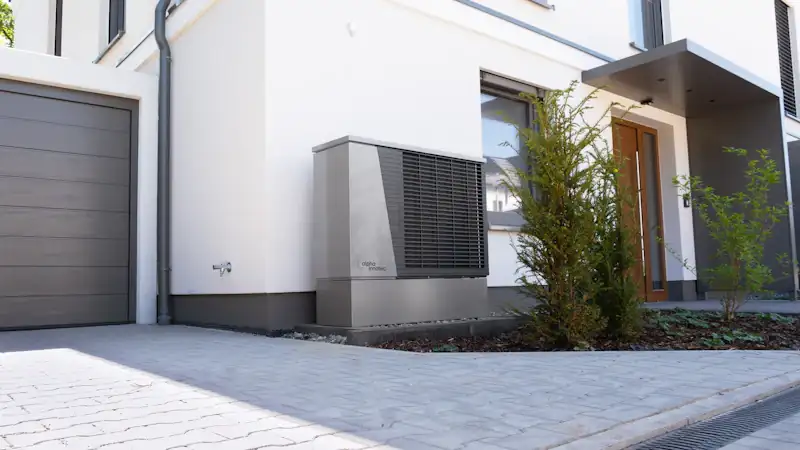
- the position of the outdoor unit: noise for the neighbours, condensate drainage, any local planning rules (street-facing facade, terraced house);
- domestic hot water: cylinder size for the size of the household;
- the hydraulic circuit: flushing out sludge, balancing the radiators, thermostatic valves;
- controls: a well-set weather compensation curve (flow temperature adjusted to the outdoor temperature) makes a real difference to consumption.
If you have solar panels, scheduling hot water production during the day lets you use part of your own output.
In Flanders, watch your peak power. Since 2023, Flemish households with a digital meter pay a capacity tariff (capaciteitstarief) based partly on their highest quarter-hour power draw each month. A heat pump that regularly falls back on its electric backup heater, or runs at the same time as an EV charger and an oven, can push that peak up. A correctly sized unit, good insulation and sensible controls help keep it down. The details are published on vlaanderen.be.
VAT and grants for a heat pump in a renovation
Since 1 January 2026, and until 31 December 2030, the supply and installation of a heat pump in a private home in principle qualifies for the 6% VAT rate, whatever the age of the home. Hybrid heat pumps are excluded from this measure: for them, the applicable rate depends on the situation of the home and should be checked with the installer. The exact conditions are published by the FPS Finance (in French and Dutch). Our guide to 6% VAT on renovation explains the general rules.
Grants differ sharply between the three regions:
- Brussels: Renolution grants have been suspended since 2025, and no new regional grant had been decided at the time of writing;
- Wallonia: the Prime Habitation scheme is in transition towards a loan-based system;
- Flanders: the heat pump is one of the few items still open to every income category under Mijn VerbouwPremie. Since 1 March 2026, the two highest income categories only receive a grant for heat pumps and heat pump water heaters, capped at a percentage of the invoice excluding VAT. See our guide to Mijn VerbouwPremie in Flanders.
Our energy grants page gives an overview, and the adviser who calls you back checks which support you can actually claim before putting you in touch with up to 3 certified installers.
Frequently asked questions
Does a heat pump work with old radiators?
Often yes, especially once the house has been insulated: old radiators are frequently oversized and can heat the rooms with cooler water. They need to be checked room by room, and only the radiators that are too small should be replaced.
Should I insulate before installing a heat pump?
It is strongly recommended. A better-insulated house needs a lower flow temperature and a smaller unit, which cuts both the investment and the electricity bill.
What flow temperature should I aim for?
Ideally between 35 and 45 °C, and preferably no more than 55 °C on the coldest days. Above that, the efficiency of a standard air-to-water heat pump falls noticeably.
Is a hybrid heat pump a good option for an older house?
It can serve as a transition while the insulation is not yet done: the boiler takes over in very cold weather. It still depends on a fossil fuel and does not qualify for the specific 6% VAT rate for heat pumps.
How do I know whether my house is suitable?
A site survey with a heat loss calculation is essential. A simple test is also to lower your boiler's flow temperature in winter and see whether the house stays comfortable enough.